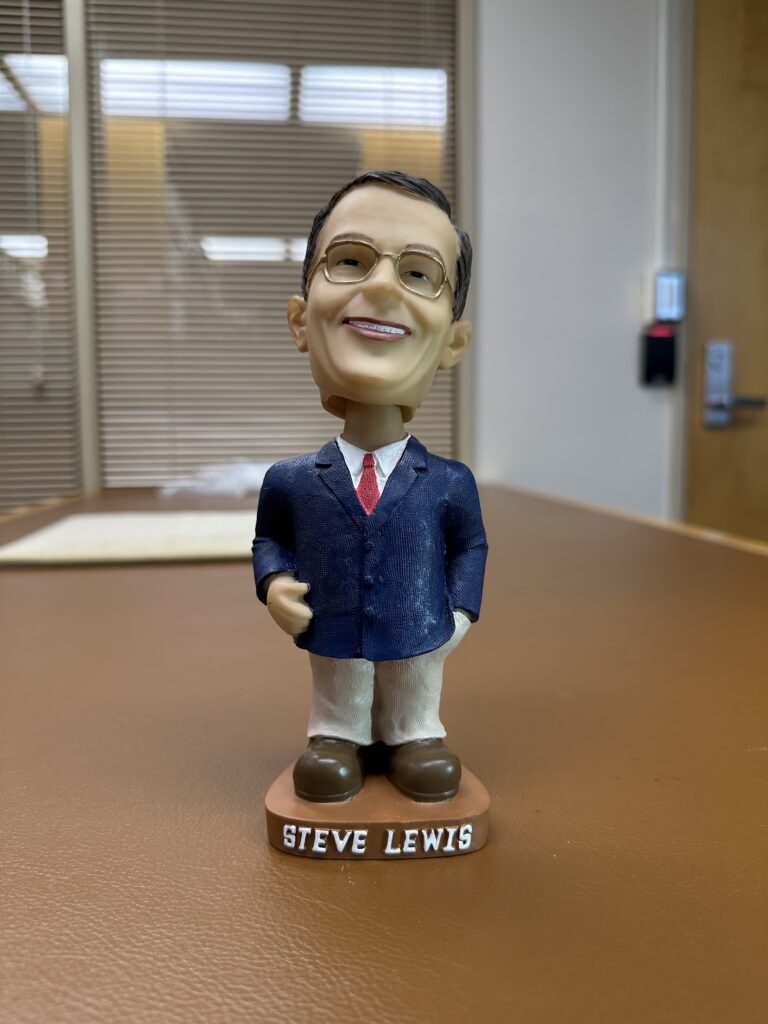
My group was creating a digital model of a Steve Lewis bobblehead. Steve Lewis served as the president of Carleton from 1987 to 2002 and it is believed that this bobblehead was given out when he retired in 2002. We took a lot of photos of the bobblehead from all angles and we also used the app Scaniverse to create a 3-D model of the bobblehead (which you can see below).
When I was taking the pictures and scanning my object with the Scaniverse app, I found myself paying a lot closer attention to a lot of details of the object I initially didn’t notice. One way that photogrammetry encourages attention to details you might have ignored is that it is really important to make sure you take pictures of the object from all different angles. Also, you need to be really aware of what parts of the object don’t get seen as much, such as the bottom or parts on the back. When making the 3-D model using Scaniverse, you can see that the backs of his elbows did not get as much detail as the rest of his body. I think that is a result of not spending enough time on that part while we were making the model. Also, while I was making the model I started to notice things I hadn’t seen before. For example, I realized how textured the bobblehead is and how detailed the face is which is really cool.
We found that trying to model this object was a very different experience to just viewing it in an exhibition. I think the biggest difference was how much we engaged with the whole object compared to viewing it in an exhibit. Often in an exhibit the item might be against the wall where you can only see the front, and it is almost always on some surface so you can’t really see it from below. However, when making a model you interact with every part of the object and when you view the model, you can rotate it and see it from any direction. I also found that when I was making the model I got a lot closer to it and was definitely more actively engaged than just walking through an exhibit and looking at it.

This is a great model! It’s really cool that you can still see the texture on the clothes, as well as the small details on the teeth and eyebrows. I liked your reflection about how when you model something you are interacting with the whole object instead of a curated view of an object that’s on display in an exhibit. I also felt that I was more actively engaged with my object through this exercise than I would have been if it was part of an exhibit.
Your model looks very good! you guys did an amazing job with the lighting and profile looks very well done. Like you mentioned above, a big part of photogrammetry is getting all the angles and making sure to get details that most people don’t notice. This was definitely achieved. I like how this object specifies that this object is from Carleton College 2002 and says that his name is Steve Lewis. Great job!
Your model looks really good! It definetly helps to have an object that you can rotate nearly 360 degrees around. I totally agree too that looking at these objects online I am less afraid of getting close and “touching” the object that I notice more things in this type of version!
I like your thumbnail picture, which grabbed my attention with the cool and funny object. I checked out your model but it was very well made with lots of details. I also noticed by looking at the model as you mentioned that the backs of his elbows did not get as much detail as the rest of his body. Just as you said, I think this activity really encouraged us to pay close attention to our objects compare to simply looking at them. Great post!