For my visualization, I decided to look at the total count made up of all the babies in New Zealand with names in the top 10 split up by gender. I used a line chart in RAWGraphs 2.0 to do this, since the y-axis values (count) are numerical and I wanted to see how the counts for both values changed with time. While this graph is interesting, there is little that one can do with it without the help of other information. For example, this graph could be improved by standardizing the counts by total number of babies per gender. This would account for differences in population size and would show how the percentage of babies per year with a name in the top 10 changed over time and how the genders compared.
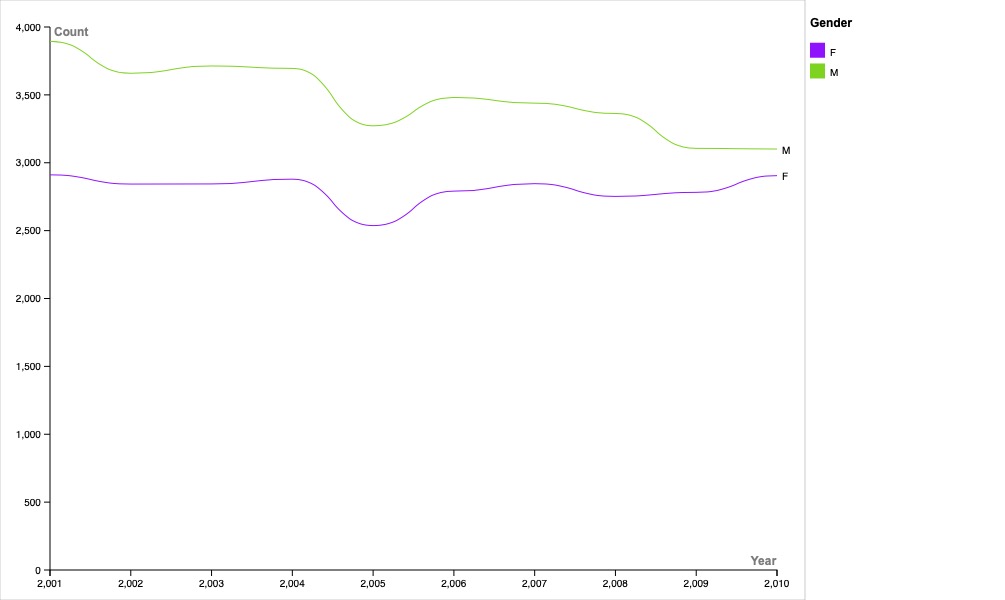
To improve the clarity of the visualization, I changed a few of the settings. Firstly, I created a legend, so viewers can see which line corresponds to the male names and which line corresponds to the female names. I also increased the margin size for the top, bottom, and right sides so that the chart wasn’t running up against the edge of the screen. Additionally, I moved the line labels to the side instead of keeping them in the default “inline” position. In the default position, the labels overlapped with the y-axis and it was hard to read them.
While my data still followed a gender binary, I tried to implement some of the techniques suggested by Catherine D’Ignazio and Lauren Klein in their chapter on data feminism, “What Gets Counted Counts”. Specifically, I used green and purple for the lines in my graph like the Telegraph members did while creating their visualization for International Women’s Day. This avoids upholding the gender hierarchy of representing men with blue and women with pink.
My visualization relates to DH in particular because it uses digital methods to display data that can be used in a variety of DH projects. Additionally, I paid attention to how the styling of my visualization could be implemented to best display my argument. This focus on design and curation fits with some of the aspects of DH that we discussed in the beginning of the term.
