This week, our lab is 3D modeling archives. Our group chose to model Isaac M. Cochran gavel.
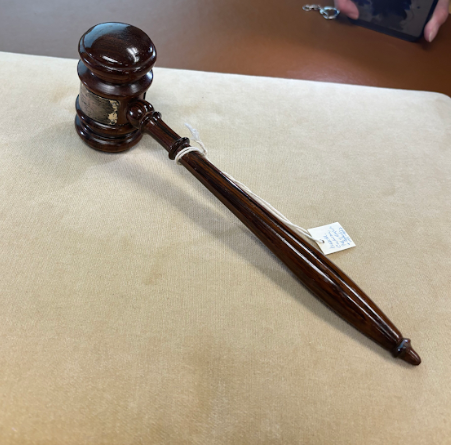
We used two different methods for this task. The first one is using the Scaniverse app for scanning and modeling. This app is easy to use. We only need to move our phone according to the on-screen instructions (areas not scanned properly are indicated with white and red stripes). The processing speed is also quite fast, with rendering completed in less than a minute. However, the lighting is crucial. Initially, our group attempted scanning in front of a projector, but the results were not good enough. With the projector turned off, the quality of the scans improved significantly, with clearer details and more well-rounded shapes.
The second method is using the phone to take photos from different angles and then using software like MetaShape or Autodesk ReCap Pro on a computer for processing. This method needs to maintain consistent lighting conditions and camera parameters throughout the photo-taking process. We captured over 50 photos and plan to work on the modeling during next Tuesday’s class.
How does attempting to model an object compare to simply viewing one in an exhibition?
When observing an object in an exhibition, I usually view it from a fixed perspective. In contrast, during the modeling process, to obtain a 3D model, I need a comprehensive observation of the object from various angles, and changing perspectives. Furthermore, objects in exhibitions are often protected by glass enclosures, creating a sense of distance between the observer and the object. However, when attempting to model an object, it is placed directly in front of us, allowing for a close examination of details.
Does the process of photogrammetry encourage close looking and attention to details you might otherwise have ignored?
During my photogrammetry experience, I have noticed a change in focus. Previously, I was more concerned with the literal and historical significance of objects. But in photogrammetry, I realized that I needed to understand the visual attributes of objects. I paid more attention to visual elements such as angles, light, shadows, and shapes.

I think you bring up a really good point in your reflection that I hadn’t really considered before, that when doing photogrammetry you need to pay a lot of attention to the light and understand how the light impacts your perception of the object. Before doing this project, I never really paid much attention to the light and how the light changed what I saw in a certain object. However, when I was creating my 3D model I started to realize how the light plays a role in my perception of the object and I think this group did a good job taking that into account when creating their 3-D model.
I was extremely surprised how much the lighting had affected the scanning process, as we used a phone with a LiDAR sensor, so it would receive some sort of depth. Initially, Austin recommended having the projector on for better lighting, such alike us providing spotlights with our phones as team members, but with the shiny gavel it was doing more bad than good. Maybe the data of reflection confused the processing power? Turning off the projector gave much better results despite the over head lights, but bad for the texture capture of the object.
I definitely agree that modeling an object makes you look at it from more angles. I feel like I rarely look closely at objects in an exhibit, but by modeling it I was forced to look at it from new perspectives. You also make a really interesting point about the glass enclosures and how it creates distance.
I worked on the same object of archival and wanted to add that I think that when attempting to model an object, you have to pay attention to its shape, texture, color, and details. You have to understand its structure and function, and how it relates to its context and history. You also have to make choices about how to represent it in a digital format, such as what level of detail, accuracy, and optimization you want to achieve. You may also be influenced by the curator’s interpretation and presentation of the object, which may not reflect its original or intended meaning. 3D scanning an object is more faithful than recreating it manually, as it preserves its original features and flaws. I feel like that’s what makes it more genuine. However, I also think that there is a place for artistic expression and creativity in digital humanities, as long as it is transparent and justified. For example, recreating a building with non-repetitive or non-stock assets can enhance its visual appeal and realism. I think that both approaches of modeling from reference and 3D scan/mapping can complement each other in different contexts and purposes.